
You need at least 1,000 nits to see a screen clearly in the sun. For direct sunlight, you typically need at least 2,500–3,000 nits to keep a display readable. For shaded outdoor areas, 1,500 nits or more is usually enough. Anything below 1,000 nits will usually wash out in strong sunlight.
That is the short answer. But brightness alone does not determine outdoor visibility. A screen that looks sharp indoors can become nearly unreadable outside because sunlight reduces contrast and creates reflections.
What Are Nits on a Monitor?
A nit is the standard unit used to measure display brightness. One nit equals one candela per square meter (cd/m²), representing how much light a screen emits from its surface. In general, the higher the nit rating, the easier a display is to read in bright environments.
When comparing displays, nits are the most useful brightness measurement because they describe the actual light emitted by the screen—not the surrounding environment. That’s why manufacturers specify monitor brightness in nits rather than lux or lumens.
Although direct sunlight can exceed 100,000 lux, a display doesn’t need to be brighter than the sun to remain readable. Instead, it only needs to produce enough luminance and maintain sufficient contrast so that images stand out against the surrounding ambient light.
This is also why brightness alone doesn’t determine outdoor visibility. Technologies such as high contrast ratios, anti-glare glass, and optical bonding work alongside high brightness to keep content clear in real-world sunlight.
How Many Nits Do You Need for Outdoor Displays?
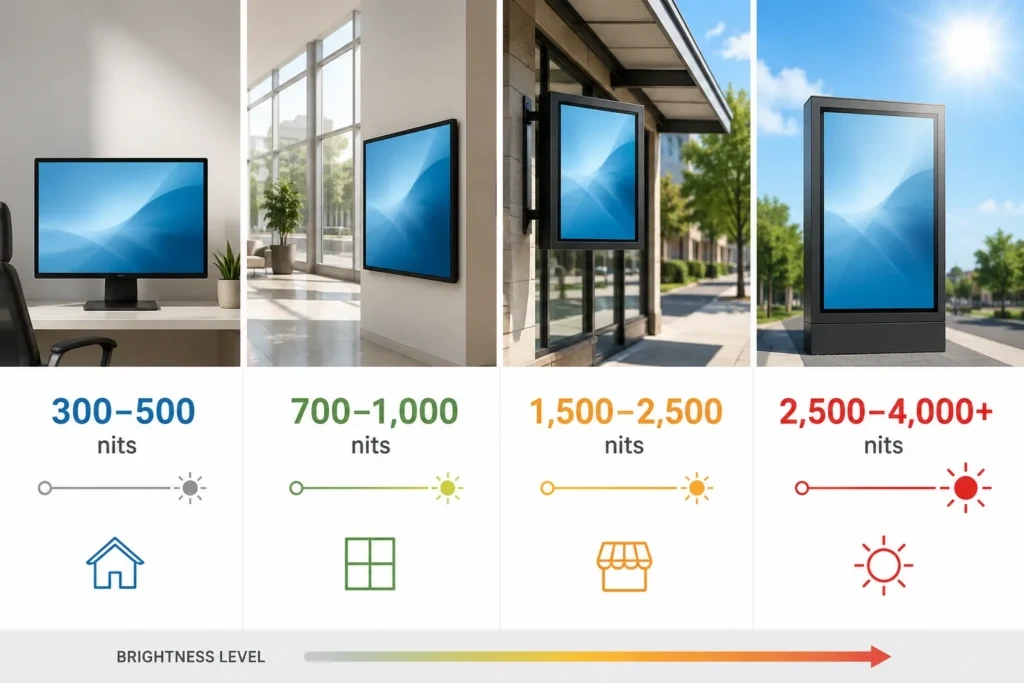
The nit requirement for an outdoor display depends entirely on how much direct sunlight it will face, not just whether it’s “outdoors.” A screen mounted under a covered walkway has very different needs than one bolted to an open rooftop billboard.
| Environment | Recommended Brightness |
| Indoor, away from windows | 300–500 nits |
| Indoor near large windows / bright lobby | 700–1,000 nits |
| Shaded outdoor, awning, or overhang | 1,500–2,500 nits |
| Full direct sunlight, unshaded | 2,500–4,000+ nits |
Tip: A common misconception is that a display simply needs a higher nit rating to perform well outdoors. In reality, brightness is only one part of the equation, and a well-engineered 2,500-nit display can outperform a poorly designed 3,000-nit display in direct sunlight.
Four Factors That Make an Outdoor Display Readable?
Outdoor screens need more nits because sunlight raises the ambient light level around the display, and the panel has to output enough light to stay visually distinct from that background glare. Four factors work together to determine real-world outdoor readability:
- Brightness (Nits) This is the baseline. Higher nits push more light output, which directly improves how visible the image stays as ambient light increases.
- Contrast Ratio A high nit count alone isn’t enough if the contrast ratio is weak. Strong contrast helps the image visually separate from washed-out background glare, especially in dark scenes or text-heavy content.
- Anti-Glare Glass Reflections off a glossy screen surface can undo the benefit of high brightness. Anti-glare coatings scatter reflected light so viewers aren’t fighting mirror-like glare from the sun.
- Optical Bonding Laminating the touch layer directly to the display panel eliminates the air gap that normally causes internal reflections. This single design choice is often what separates a genuinely sunlight-readable display from one that’s simply “high brightness on paper.”
Expert Tip: In our experience specifying outdoor kiosks and signage, two units with identical nit ratings can perform very differently in the field — the one with optical bonding and a properly rated anti-glare coating will consistently outperform a bare high-brightness panel in real sunlight testing.
How to Choose the Right Brightness for Your Outdoor Display
Choosing the right brightness comes down to matching the nit rating to your actual installation conditions, not just picking the highest number available. Before specifying a display, walk through this checklist:
| Factor | Why It Matters |
|---|---|
| Installation Environment | Indoor, covered outdoor, and fully exposed locations require very different brightness levels. |
| Direct Sunlight Exposure | Displays facing direct sunlight for long periods typically need 2,500–4,000+ nits to remain readable. |
| Viewing Distance | Displays viewed from farther away often benefit from higher brightness to improve visibility, especially in daylight. |
| Content Type | Text, maps, and menus require stronger contrast and higher readability than image- or video-focused content. |
| Operating Hours | Displays running all day may benefit from automatic brightness adjustment to reduce power consumption and extend component life. |
| Display Design | Features such as anti-glare glass and optical bonding can improve readability without relying solely on higher brightness. |
Getting this right upfront avoids two common mistakes: overspending on brightness the environment doesn’t need, or under-speccing a display that becomes unreadable the moment the sun hits it directly.
Choosing the Right Brightness for Outdoor Displays
Selecting the right outdoor display isn’t about choosing the highest nit rating—it’s about matching the display to its installation environment. A screen used under a covered walkway has very different brightness requirements from one installed in full, direct sunlight.
As a general guideline, 1,500–2,500 nits is suitable for most shaded outdoor applications, while 2,500–3,000+ nits is recommended for displays exposed to direct sunlight. However, brightness alone doesn’t guarantee visibility. Features such as high contrast ratios, anti-glare glass, and optical bonding are equally important for maintaining clear, readable content outdoors.
By evaluating both the lighting conditions and the display’s optical design, you can choose a solution that delivers reliable performance without overspending on unnecessary brightness.
Need help selecting the right brightness for your project?
Our team can recommend the ideal outdoor display based on your installation environment, viewing distance, and application requirements. Contact us today for expert advice and customized display solutions.
❮🔵 Get Your Custom Outdoor Display Solution❯
FAQ
Is 1000 nits Bright Enough For Outside Use?
Only in partial shade or transitional environments. It usually struggles in full sun.
Does optical bonding increase brightness?
Not directly. Optical bonding doesn’t increase the display’s actual nit rating, but it significantly reduces internal reflections and improves perceived contrast, making the screen appear much clearer in sunlight.
Does anti-glare glass reduce reflections?
Yes. Anti-glare coatings scatter reflected light across the glass surface, reducing mirror-like reflections and making content easier to read outdoors.
Is 5,000 nits too bright?
Not for applications exposed to intense direct sunlight. High-brightness displays often rely on automatic brightness control, allowing the screen to reduce brightness during cloudy conditions or at night to improve energy efficiency and viewing comfort.