Outdoor digital signage has moved from a “nice-to-have” marketing extra to a core piece of infrastructure for retailers, restaurants, transit authorities, and smart cities. But buying the wrong display — one that fades in direct sunlight, fogs up in winter, or fails after one rainy season — is an expensive mistake. This guide walks through everything you need to know before you buy: what outdoor digital signage actually is, the display types available, the features that separate a durable installation from a costly write-off, and a realistic breakdown of what it will cost.
What Is Outdoor Digital Signage?
Outdoor digital signage is a digital display system built specifically to operate outside — exposed to direct sunlight, rain, heat, cold, dust, and humidity — while remaining readable and reliable around the clock. Unlike an indoor screen repurposed with a protective case, true outdoor digital signage is engineered as a complete system from the ground up.
A typical outdoor signage system is made up of several components working together:
- Panel — the LCD or LED display itself, rated for high brightness and outdoor visibility
- Enclosure — a sealed, weatherproof housing that protects internal electronics from moisture, dust, and impact
- CMS (Content Management System) — the software layer used to schedule, update, and monitor content remotely
- Power system — stable power delivery designed for continuous 24/7 operation, often with surge protection
- Cooling and heating system — thermal management that keeps internal temperatures within a safe operating range regardless of the season
This category sits within the broader world of DOOH (Digital Out-of-Home) advertising, which uses networked displays in public and semi-public spaces to deliver dynamic, sunlight-readable content that traditional static signage simply can’t match.
Benefits of Outdoor Digital Signage
Top Use Cases
Outdoor digital signage shows up across a wide range of industries, each with different demands:
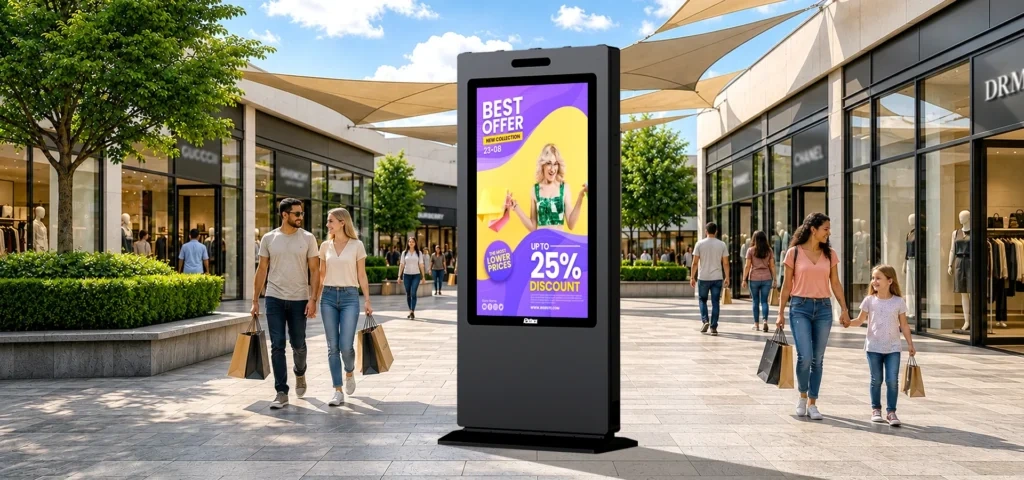
- Retail — storefront displays, window signage, and parking-lot digital menu boards that drive foot traffic and promote in-store offers
- QSR (Quick Service Restaurants) — drive-thru menu boards that update pricing and promotions instantly, without reprinting a single sign
- Transportation — arrival/departure boards, wayfinding, and platform advertising at airports, train stations, and bus terminals
- Smart City — public information kiosks, wayfinding displays, and municipal advertising panels integrated into city infrastructure
- Hospitality — outdoor directories, event boards, and promotional displays at hotels, resorts, and entertainment venues
Key Benefits
- Visibility — high-brightness outdoor displays remain legible even in direct sunlight, something printed signage and standard indoor screens can’t achieve
- Engagement — dynamic content (video, animation, real-time updates) captures more attention than static signs, and content can be changed instantly to match promotions, weather, or time of day
- Revenue — QSR operators frequently use digital menu boards to run dayparting promotions and upsell combos, directly influencing purchase decisions at the point of sale
- Operational efficiency — updating pricing or messaging across an entire network of displays takes minutes through a CMS, compared to days or weeks for printed signage replacement
Outdoor Digital Signage Display Types
Not all outdoor displays are built the same way, and the right technology depends on viewing distance, environment, and budget.
- High-brightness outdoor LCD — the most common choice for retail storefronts, menu boards, and information displays under roughly 100 inches. LCD panels offer sharp resolution at close viewing distances and are generally more cost-effective than LED at smaller sizes.
- Outdoor LED displays — built from LED modules with a specific pixel pitch (the distance between individual LEDs). LED is the go-to solution for large-format billboards and displays viewed from a distance, where seamless scalability matters more than close-up pixel density.
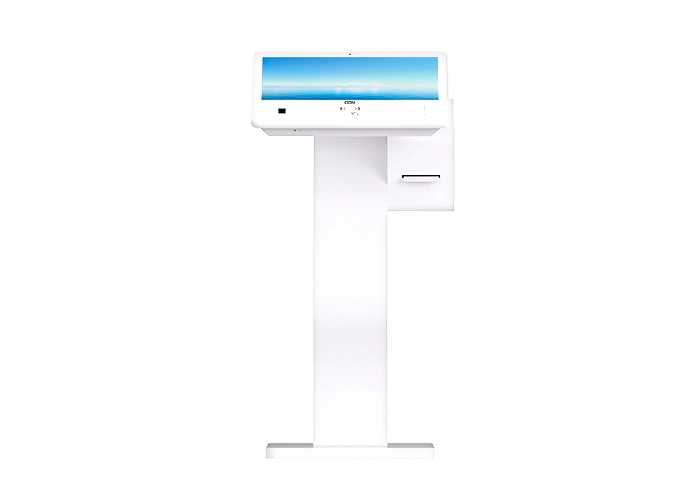
- Interactive outdoor kiosks — touchscreen-enabled displays used for wayfinding, self-service ordering, and public information terminals. These typically combine a high-brightness panel with a rugged, vandal-resistant touch layer.
Choosing between LCD and LED usually comes down to viewing distance and screen size: LCD for close-range, detail-rich content; LED for large-scale, distance-viewed advertising.
Key Features to Look For
After manufacturing and deploying outdoor digital signage for retail stores, transportation hubs, and smart city projects, we’ve found that most failures are caused by incorrect specification rather than product quality.
Brightness (nits). Outdoor displays need significantly higher brightness than indoor screens to remain visible in direct sunlight. Most reputable outdoor displays start at 2,500 nits, with premium high-brightness units reaching 4,000–5,500 nits for full direct-sun exposure. Indoor-rated screens typically max out around 400–700 nits and will appear washed out or invisible outdoors.
IP rating (IP65 / IP68). The Ingress Protection rating indicates how well a display resists dust and water. IP65 is the common minimum for outdoor signage, indicating protection against dust ingress and low-pressure water jets from any direction. IP68 offers an even higher level of sealing, important for displays in coastal, high-humidity, or flood-prone environments.
IK rating (impact resistance). An IK10 rating means the display can withstand significant impact — important for street-level installations exposed to vandalism, accidental contact, or debris.
Anti-glare and optical bonding. Optical bonding fuses the display glass directly to the LCD panel, eliminating the air gap that causes internal fogging, reduces glare, and improves durability against impact. Anti-glare coatings further improve readability in bright, direct sunlight.
Thermal management. Outdoor displays generate heat internally and absorb heat from the sun, while also needing to function in freezing conditions. A proper cooling and heating system — fans, heat sinks, or in extreme climates active heating elements — keeps the panel within its rated operating temperature range year-round.
24/7 operation and power stability. Applications like transit signage or QSR drive-thru boards run continuously. Look for displays rated for true 24/7 duty cycles, with stable power supplies and surge protection to prevent failures during storms or grid fluctuations.
Vandal-proof and waterproof construction. Beyond IP and IK ratings, look at the overall enclosure design — tamper-resistant fasteners, reinforced housings, and sealed cable entry points all contribute to long-term reliability in public spaces.
Choosing the Right Display for Your Environment
The “best” outdoor display depends heavily on where it will be installed. A screen that performs well in a dry, temperate climate may fail quickly in a coastal or desert environment.
Key environmental factors to evaluate:
- Direct sunlight exposure — how many hours per day, and at what angle, will the display face the sun? This affects both brightness requirements and heat load.
- Heat dissipation — in hot climates, active cooling becomes essential to prevent thermal shutdown or shortened component lifespan.
- Humidity and coastal corrosion — displays near coastlines face salt-air corrosion, which requires corrosion-resistant housings and higher IP ratings.
- Cold and freezing conditions — in cold climates, look for built-in heating elements that keep the panel operating below freezing without condensation forming inside the enclosure.
Content Management (CMS)
The physical display is only half the system — the CMS is what makes outdoor signage practical to operate at scale. Look for:
- Remote updates — the ability to push content changes to one screen or an entire network from a central dashboard, without an on-site visit
- Scheduling and automation — dayparting, promotional calendars, and rules-based content triggers (e.g., different content for weekday lunch vs. weekend evening)
- Security and monitoring — real-time device health monitoring, uptime alerts, and secure access controls to prevent unauthorized content changes
- Integration with sensors and cameras — some deployments tie signage content to occupancy sensors, weather data, or audience-detection cameras for context-aware advertising
Installation & Maintenance
Power and connectivity. Confirm power requirements early — outdoor installations often need dedicated circuits, weatherproof conduit, and reliable network connectivity (cellular, Wi-Fi, or hardwired ethernet) for CMS updates.
Mounting and safety. Outdoor displays are heavier and more exposed to wind load than indoor units. Structural mounting, proper grounding, and compliance with local electrical and building codes are essential — this is not a DIY wall-mount job.
Ongoing maintenance. Budget for periodic cleaning (especially in dusty or coastal environments), seal inspections, and firmware updates. A good supplier will offer a maintenance plan or at least clear guidance on service intervals.
Outdoor Digital Signage Cost Breakdown
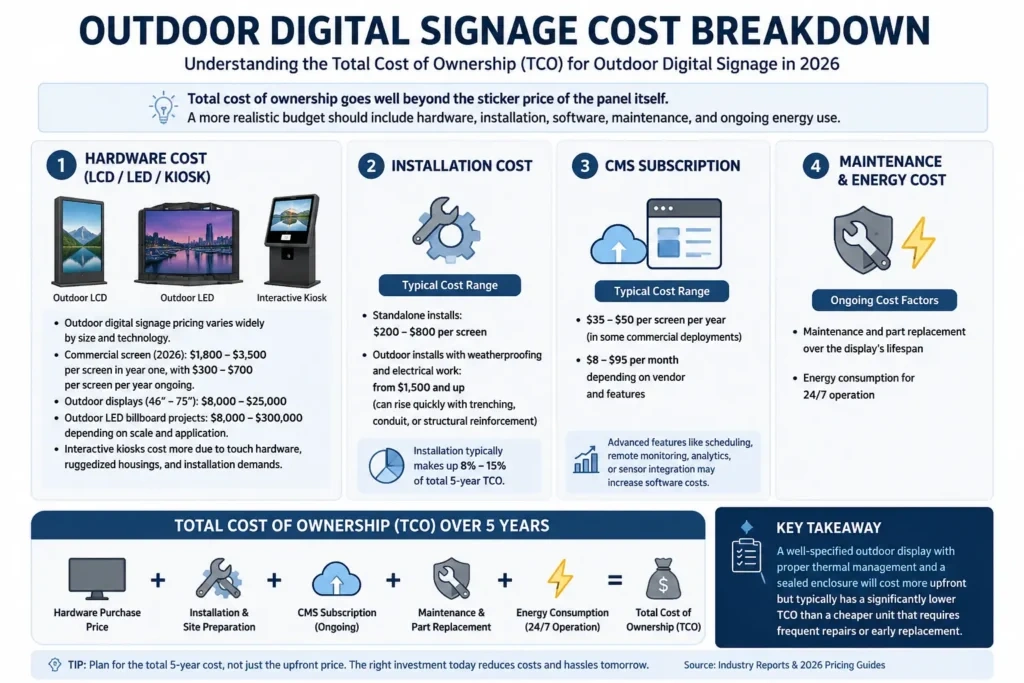
Total cost of ownership goes well beyond the sticker price of the panel itself. A more realistic budget should include hardware, installation, software, maintenance, and ongoing energy use.
Hardware Cost (LCD / LED / Kiosk)
Outdoor digital signage pricing varies widely by size and technology. One 2026 pricing guide puts a fully installed commercial digital signage screen at $1,800–$3,500 per screen in year one, with $300–$700 per screen per year ongoing, while outdoor-specific installs can climb much higher depending on brightness and enclosure requirements. For larger outdoor projects, a TCO guide lists outdoor displays (46–75″) at $8,000–$25,000, and outdoor LED billboard projects can range from $8,000 to $300,000 depending on scale and application. Interactive kiosks typically cost more because they add touch hardware, ruggedized housings, and more demanding installation requirements.
Installation Cost
Installation is often underestimated, but it can be a major part of the budget. Typical standalone installs are often $200–$800 per screen, while outdoor installs with weatherproofing and electrical work can start around $1,500 and rise quickly when trenching, conduit, or structural reinforcement is needed. A TCO breakdown also shows installation typically makes up 8%–15% of total 5-year TCO, which is why site conditions matter so much in the final budget.
CMS Subscription
CMS pricing is usually a recurring cost, not a one-time expense. In one 2026 cost guide, software is listed at $35–$50 per screen per year in some commercial deployments, while another guide shows $8–$95 per month depending on vendor and features. If your project needs advanced scheduling, remote monitoring, analytics, or sensor integration, expect the software tier to rise accordingly.
Total Cost of Ownership (TCO)
When budgeting, factor in:
- Hardware purchase price
- Installation and site preparation
- CMS subscription (ongoing)
- Maintenance and part replacement over the display’s lifespan
- Energy consumption for 24/7 operation
A well-specified outdoor display with proper thermal management and a sealed enclosure will cost more upfront but typically has a significantly lower TCO than a cheaper unit that requires frequent repairs or early replacement.
Case Studies
Retail
Outdoor digital signage helps retail chains promote seasonal offers at the storefront and parking lot. In one Fugo case study, Goldilocks managed 900+ locations from a single platform, showing the scale advantage of centralized CMS control.
QSR
Outdoor digital menu boards can improve speed and upselling for quick-service restaurants. Samsung reported that a 10-store pilot produced more than $1.4 million in additional profit and over $1 million in cost savings.
Transportation
Airports and transit systems use outdoor-rated displays for real-time information and wayfinding. Tampa International Airport’s signage deployment shows how digital displays can improve the passenger experience across terminal spaces.
Smart City
Smart city kiosks combine wayfinding, public notices, and advertising into one system. Google Cloud says IKE Smart City serves 17 U.S. cities, illustrating how public digital infrastructure can scale and create value.
Why Work with an Outdoor Digital Signage Manufacturer?
Buying outdoor signage isn’t just a hardware purchase — it’s a long-term infrastructure decision. Working directly with an experienced outdoor digital signage manufacturer or supplier gives you access to customization, project support, and quality assurance that off-the-shelf resellers often can’t match.
OEM Customization
An OEM display manufacturer can tailor brightness levels, enclosure design, mounting brackets, and even branding to fit your specific deployment environment and use case — rather than forcing your project to adapt to a generic off-the-shelf unit. This is especially valuable for large rollouts where consistency across dozens or hundreds of sites matters.
Project Support
A capable digital signage solution provider offers more than a box on a truck: site surveys, installation guidance, CMS onboarding, and ongoing technical support throughout the life of the deployment. This kind of end-to-end support significantly reduces the risk of costly installation mistakes.
Quality Certification
Before committing to a supplier, verify their certifications:
- CE — confirms compliance with European health, safety, and environmental protection standards
- FCC — required for electronic devices sold in the United States, confirming electromagnetic compatibility
- RoHS — restricts the use of hazardous substances in electronic components
- Warranty — a clear, comprehensive warranty is one of the strongest signals of a manufacturer’s confidence in their own hardware; scrutinize what’s covered (panel, backlight, power supply) and for how long
Bottom line: the right outdoor digital signage display comes down to matching brightness, IP/IK ratings, and thermal management to your specific environment, backed by a CMS that makes day-to-day operation manageable and a manufacturer that stands behind the hardware long after installation.